Saturday, April 28, 2012

How to Build a Chhorten


We had originally planned to construct a large, deep amphitheatre below our IT Park building, but that area is very boggy, with surface moisture, underground streams and constant seepage.  We’ve had 4 different excavator operators come in to start digging foundations, but all have managed to get stuck in the quagmire and have left the site shaking their heads. Our geophysical survey report tells us that the water table starts just under the surface and continues in some spots to a depth of 45 metres!


Rather than fight Mother Nature, we decided to work with her, and I proposed instead to create a beautiful marsh garden in that area, using large trees, colourful flowering plants and local grasses suited to the conditions.

We’ll have a spectacular waterfall tumbling down into a rock-strewn little cove, which feeds into two running streams. These streams will converge to fill a large pond area, before spilling over into yet another stream that meanders to the bottom of our 5 acres, and eventually finds its way to the Wangchu River , a couple of kilometres away.

Most of the initial shaping and early planting work for the marsh garden has now been completed, but possibly the most important feature is being constructed right now.

A chhorten is a (usually small) religious monument that houses sacred items, creates good karma and blessings, and is revered by all Buddhists. The construction of new highways and buildings is always planned so as not to disturb existing chhortens.

Some special ones contain a prayer-wheel that is driven by water, and that is what we are constructing on our site.

Here is a typical modern, free-standing chhorten, located in the town of Dochula and built for tourists. It even houses a telescope to view the mountains!


The one I envisaged for our site was to be slightly more rustic and traditional in style. We had some local architects design a couple for us, but these were too formal in appearance and lacked the earthiness and natural energy that we seek for this special area.

A Bhutanese friend put me in touch with some men from an outer village, who specialise in building traditional chhortens in rural areas. When I met them to discuss our project, they understood instantly what was required, and a few days later, their team of 5 men took up residence on our site and began work.


After first temporarily diverting the stream away from their work site, the men dug foundation holes for the structure...


... and because the chhorten will be in constantly running water, and straddling the muddy stream banks, they erected steel reinforced concrete pillars for strength.


The next day, using stone left over from other projects on the site, up she goes!


This guy even remembered to leave himself an escape route...the lower hole is where the stream will flow through after turning the propeller.


It was only a couple of days before the roof framing started. This was made from local blue pine timber, for religious significance as well as being a great choice for the purpose...long lasting as well as insect and water repellent.


Those dozens of ornate, wooden cornices are individually hand-carved before being placed in a specific arrangement.

Ready to put on the lid....


Corrugated iron for strength, durability and waterproofing...


And of course some colour, with natural paints made from rocks, earth and minerals gathered from the far-flung areas of Bhutan.


This will be the crown...


Roofing timbers are made from hand cut slats of local cypress, symbolically held in place with stones from the nearby Wangchu River. (The galvanised nails helped too, I'm sure!)


The hand-shaped (with a machete!) cypress wheel will support the 4000 paper prayer sheets...


This pipe will be submerged in the stream and direct the water flow onto the propeller to spin the prayer-wheel.


The propeller...with a modern and very strong wheel-bearing to ensure reliable, long-lasting service!
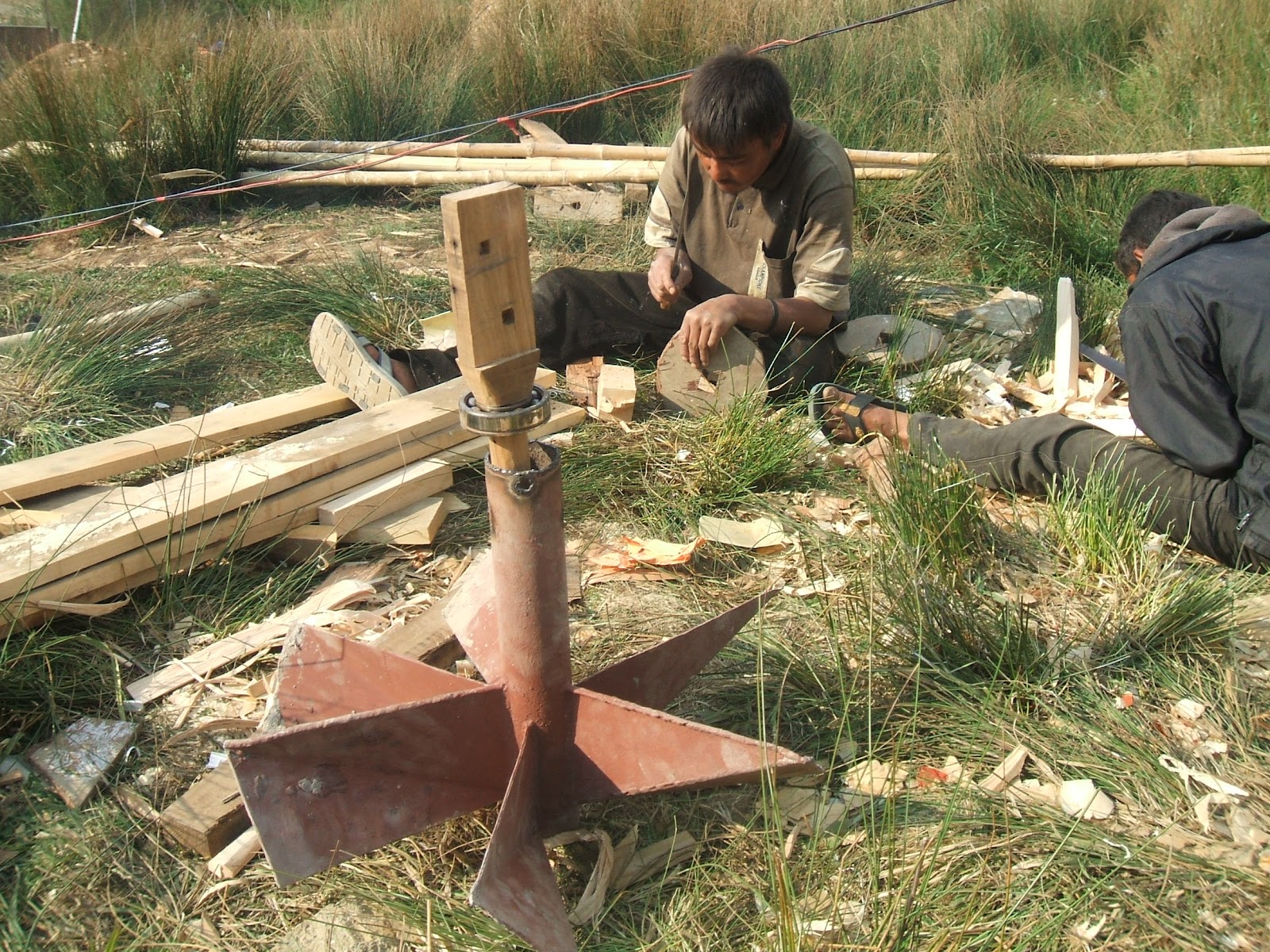


The slope between the chhorten and the main building will be cleared and planted with grass and shrubs this week...


 4000 sheets of paper prayers (I didn't count them), already blessed and waiting to be rolled around the timber shaft inside the prayer-wheel.


Half the prayers in place, wrapped in silk cloth...another roll will be added on top of these.


A steel sheet, painted and wrapped around the prayers to keep them dry for the next 100 years or so.
This will be finished by hand-painting of beautiful, traditional Bhutanese motifs.


An ornate door to seal the prayers inside.


Preparing the prayer-flags on bamboo poles...


A close-up of the prayer-flag. No, I can't read it, either!


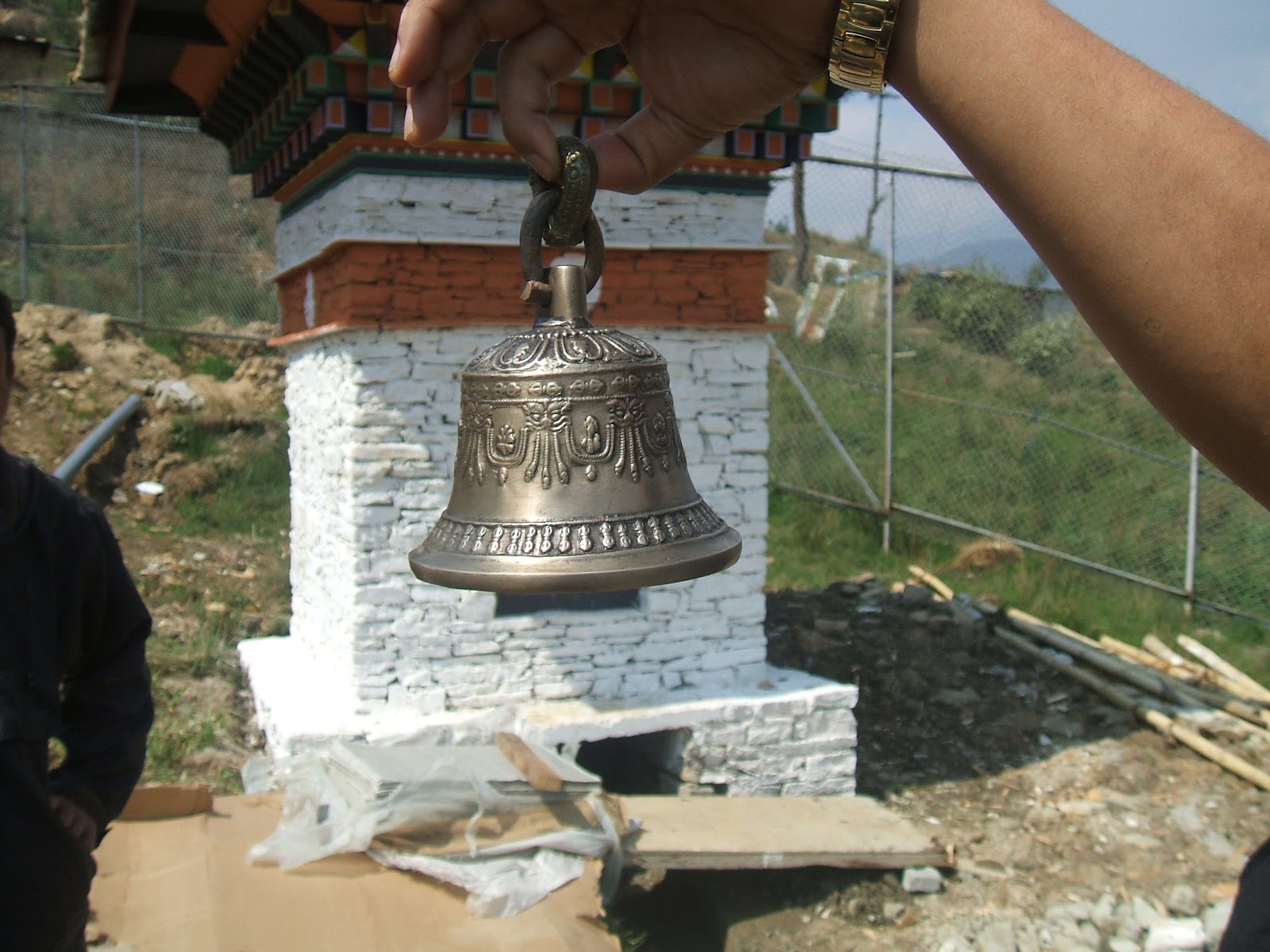
Beautiful brass bell that will be mounted inside the chhorten. As the wheel gently turns in the stream, a small rod will strike the bell and chime for all to hear. And it has a sweet sounding note, too.
The ring being held is in the shape of a dragon, the famed "Druk" (Thunder Dragon), after which Bhutan is named.


An auspicious day was chosen for the official blessing by local monks...


The prayer-flags send their messages on the winds...


The stream will be diverted back through the chhorten...

And THAT is how you build a chhorten!


Sunday, April 1, 2012

A Walk in the Park

We're just now seeing the end of a bitterly cold Winter and the welcome first signs of Spring. Progress on site is accelerating, the workers are remarkably compliant, and the sweet perfume of blossoms is all around. 

While everybody's spirits have lifted and the pace of work has increased noticeably, it's still frustrating from a landscaping viewpoint.

We're only a week or so away from the final landscaping and actual installation/planting, but it doesn't look like it...


In the almost 18 months I've been here now on this project, I've been able to observe the full cycle of seasons and weather, and more closely study and understand the soil, as well as meet local experts and exchange ideas. And that's a great thing, because many of my original plans, especially in choice of plants, have changed.

Hardy trees and shrubs that may struggle through a less severe winter than Bhutan's, don't have a hope here. They curl up their toes and die. And this landscape, when completed, needs to be low maintenance.

So today I decided to mix business with pleasure, and took a stroll up the hill to the Royal Botanical Gardens, to see what was happening in their displays. 

Remember, this is no lush, tropical rainforest here...it's survival of the fittest!


A typically quaint greeting...


But don't be fooled. This is FAR more than just a garden display...


The entrance provides a reassuring welcome...


 Hedges are really popular here....


...but these paths were leading somewhere, so I followed....

Past the chhorten with its water-driven prayer wheel. We're building a similar one in the IT Park marsh-garden next week...

 
...and a lovely waterfall. We're creating one of those at our site, too!


...over the traditional cantilevered bridge... (no plans for one of these, but it's got me thinking)...


..and yet ANOTHER sign...


Then, just around the corner, a traditional Bhutanese picnic. And just like everywhere else, men grouped on the left talking football, women on the right under a tree talking about...I never could work that out!


Continued past some lovely blossoming cherries and magnolias...


..and was suddenly struck with a wonderful wave of nostalgia. Something I could smell and instantly  recognise before I even saw it...Australia's national flower, the Wattle.
High in the Himalayas!
Actually felt a little choked up at this...must have got some pollen in my throat...


By now, the path was leading up towards a lookout point I remembered from a previous visit...


And there's a reason it's called a "lookout"...


 After a brief hour or so of quietly taking in the view and contemplating life, it was time to get back to work, refreshed, recharged and with a few new ideas.

So back along the path...


...out the gate...


past a man in a funny hat...


and took a new  shortcut where I was rewarded with a view of our work-site I'd never seen before...a nice ending to a day of new perspectives.


Sunday, March 18, 2012

Reflections


I’ve been living and working in this truly wondrous country for about 16 months now, and just a couple of days ago, returned from a quick trip home to Australia, where I visited family, friends and old stamping grounds. It also gave me time to reflect, from a distance, on the nature of life in one of the most intriguing nations on the planet. Bhutan is a nation truly at the crossroads of its future; a most enviable yet extremely daunting place to be.

This blog is never meant to be about me, but in order to explain my own thoughts on this country, a little background may help.

I accidentally spent many years working in the corporate world in Australia, climbing as one does, the slippery rungs of that clichéd ladder to achieve a modest level of success, before throwing it all in to follow my passion of horticulture. But even in those days of hustling, bustling meetings, appointments, business-travel, budgets, deadlines, suits and ties, I never really believed it was important in the grand scheme of life. I was always able to step back mentally, observe life as an outsider and treat it as a psychological and sociological experiment on myself, on those with whom I interacted, and on society at large.

People who know me also know that I constantly rant and rage against overt capitalism, rampant consumerism, the uncaring greed and selfishness of individuals and corporations. The dog eats dog existence of a materialistic world where “things” come before all else. A widespread deficit of “soul”, and the inability or lack of desire to put the needs of others first. The gross injustices and inequalities of society have always rankled with me badly.

That all sounds a bit bleak and gloomy now that I see it on the written page, but strangely, I’ve always considered myself to be an optimist...so here’s a pretty picture to momentarily break my tirade...my grandson, Jack!


Bhutan existed, deliberately isolated and blissfully untouched by the rest of the world until 1950, when China invaded nearby Tibet. Not unexpectedly, that set off the alarm bells, and to paraphrase decades of history, Bhutan’s king made the decision to align his country with neighbouring India and to embark upon a national program of modernisation. Royal rule gave way to a democratically elected government (although the Royal Family still has an enormously strong presence and is genuinely loved by the people.)

This Himalayan Kingdom of Bhutan is often thought of and referred to by westerners as “Shangri-La”, and while of course perfection is unattainable, I believe this country is closer to it than any other. Simply because it has been protected from and unsullied by most of the vices of the rest of the “civilised” world. But (to misquote Shakespeare!), therein lies the rub.

Due in part, I am sure, to the recent introduction of television and western media, the people here want a more modern lifestyle, with easier travel, better and wider communications, new technologies, exotic foods and all the creature comforts enjoyed by more developed economies. And of course they should have these things.
  
But the benefits of modern living always come with strings attached. Drugs, crime, cultural cynicism, a loss of innocence, a more frenzied pace of life, and yes, capitalism and its attending greed, jealousies and other ugly traits. While no-one would claim the basic human failings don’t exist here, they are greatly diminished in this peaceful Buddhist nation.


It is this conundrum that the nation’s leaders are trying to solve, in an extremely delicate balancing act.
And these are very clever people trying to solve their nation’s greatest problem.

The current King was educated at Oxford and all government ministers are required to have a university degree before standing for election. Collectively, they have studied at some of the world’s greatest educational institutes.

This may be the planet’s last chance to get it right. Here is a nation that hasn’t imploded yet, still has the opportunity to set up that Utopian society, and the high government officials and key decision makers are well aware of this fact. This is why I feel so lucky and privileged, and excited to be here as this transition takes place.

So, although I’m just one person with a dream rekindled, I’ll do anything within my ability to help, figuratively and literally, to Landscape Bhutan.


STOP PRESS: An interesting and  related article in today's The Guardian newspaper for anyone with the time and inclination to read it...

http://www.guardian.co.uk/sustainable-business/bhutan-advise-united-nations-happiness