Friday, October 12, 2012

Road Trip to Remember

Spent 4 days last week on a long-anticipated trip to the beautiful eastern part of Bhutan. After nearly 2 years living and working here now, I've probably seen less of the countryside than the tourists who come for 7 days!

I travelled with a couple of new friends working in Thimphu (the capital) with me...Zoltan, a Hungarian living in Belgium, and Axel, a German. We hired a good car, and with our trusty local driver, LB, set off for Bumthang, with a halfway overnight break in the glorious valley of Phobjikha.http://en.wikipedia.org/wiki/Phobjika_Valley

This valley is famous for the black-necked cranes that visit annually, 'though unfortunately not until the end of this month, so we missed seeing them. But we also missed the tourist rush, so not a bad result.

The next day we moved on to Bumthang, http://www.tourism.gov.bt/where-to-go/bumthang.html often referred to as the spiritual heart of this Buddhist kingdom. We stayed 2 days there before attacking the 250km, 10 hour return trip. That's a normal speed for travelling on the roads in this country. High altitude, poorly-surfaced, narrow and winding tracks with fatal drop-offs should an accident or landslide occur. But this is not a country where people are in a hurry. And neither were we.

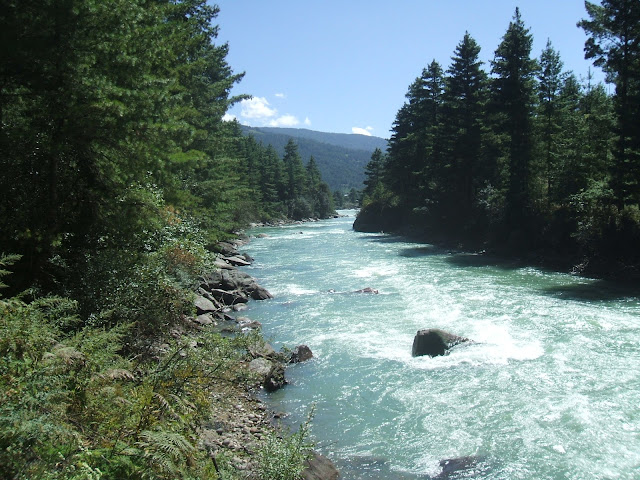
So the following is basically a compilation of photos of what we saw on the trip. You'll see what we saw.  If you like beautiful scenery, rivers, waterfalls, temples, snow-capped mountains and happy Bhutanese faces, you should enjoy it.

If that's not to your taste, you can always turn on the TV...


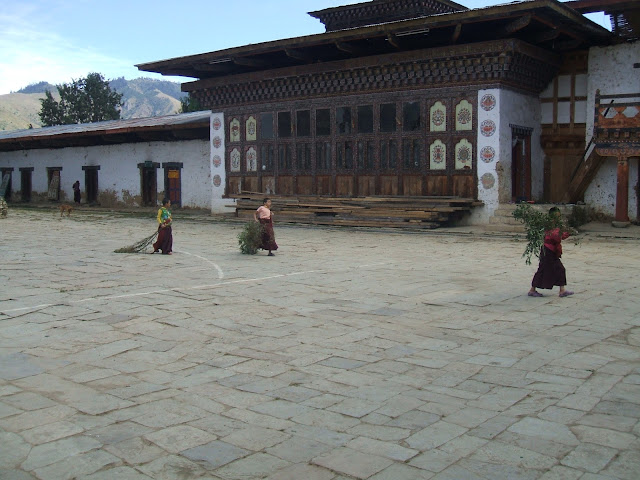
This is the Wangdue Dzong, built in 1638 and tragically destroyed by fire in June 2012. But in the inimitable Buddhist way, already in the process of being rebuilt.


The lovely guesthouse we stayed in overnight at Phobjikha


Digging Bhutan's best potatoes, in Phobjikha.


 Our Bumthang accommodation...


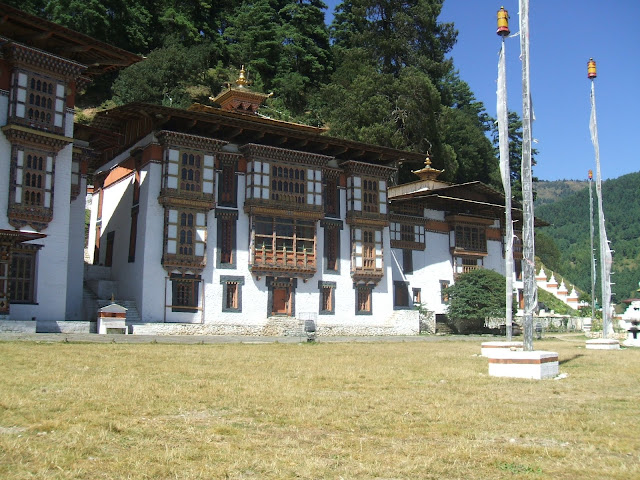
In Bumthang, Bhutan's oldest temple and monastery, built around 650 AD


Junior monks having a music lesson


Monday, October 1, 2012

Tsechu...Bless You!

Last week we had a 3 day holiday to celebrate Tsechu, a Buddhist festival that stops the entire nation of Bhutan. The origins of this event are steeped in ancient rites and mysticism, but unusually, Wikipedia seems to offer a good approximation of it...
http://en.wikipedia.org/wiki/Tsechu

Because the whole country participates in this day, and thus I could not find even one worker to cajole into joining me at our project site, I ventured down to the Thimphu Tashi Cho Dzong to witness the occasion. And what a spectacle it proved to be!

An open-air, (I have the sunburn to prove it), packed-house of excitement, enchantment and surreal colour, music and movement, all pulsating with unbounded joy for the participants and the audience alike.

Again, my poor little cheap "point-and-shoot" camera was not up to the task. I pointed it and shot it, but could never capture the true magnificence of the occasion.

So this is the best I can offer, starting with the approach to the arena...


Tuesday, September 25, 2012

Kolkata (Oh, Calcutta!) Excursion


Yes, you are correct. This isn't about Bhutan, but I've been travelling  fairly often lately, mainly to Bangalore and Kolkata (aka Calcutta) in India, and recently went for a quick walk through the Kolkata Botanic Gardens, so I will claim that this is still "landscape" related!

Kolkata is extremely hot, humid and gritty. I find the weather very uncomfortable and can only spend a couple of days there before feeling the need to move further south to more temperate, cleaner and greener Bangalore.

The Botanic Gardens in Kolkata have some very unusual plants, including one that is unique...according to the Guinness Book of Records, the world's largest Banyan tree. It covers an area of 1.5 hectares (almost 4 acres), and is more than 250 years old.

For those who don't know the growth habit of Ficus benghalensis, the trees send down aerial roots from their branches, which hit the ground , grow roots of their own, turn into other trees and spread accordingly. Often the original parent tree dies, but its progeny keep growing. So the images you see that look like a group of trees, are in fact just one. Trust me on this! And for anybody who knows what originally took me to India back in March 2010, the Banyan holds great personal significance...

There are also pics of giant water-lily pads (1.5 metres across), a mongoose looking for snakes to eat, various pretty flowers and trees, and a gratuitous shot of a container ship on the River Ganga (Ganges).

Unfortunately, the camera suffered from humidity as much as I did, so they're not all shots of the highest quality, but I'm sure you'll get the picture...(see what I did there?)


Tuesday, July 3, 2012

Hallucinogens…Happy Haloes, or Harmful Habits?


In the process of preparing our 5 acres around the building, to create the tree-studded sweeping lawns with their floriferous borders, much time has been spent on sculpting and leveling rocky ground, adding topsoil and particularly in removing weeds.

And there are plenty of weeds, especially now with the warm summer and its accompanying monsoon rains upon us.

One of the first sights that strikes visitors to Bhutan is the profusion of marijuana that grows literally everywhere. It’s probably this country’s most prolific weed. It thrives on roadsides, in home gardens and vegetable patches, on sports fields, in cracks in the footpaths, on vacant land and in the forests. I’ve even seen it growing in weedy gutters high on the roofs of buildings. It’s commonly collected and fed to the local pigs. Gives a new meaning to the old expression “when pigs fly”!

While the weeds here are many and varied, 3 are predominant, and while not related botanically, they strangely have something in common…

I’ve grabbed parts of the following descriptions from the ‘net, so please excuse the underlined links and attributions included in some of them…


Cannabis sativa (marijuana) 

In my teenage years I could never have imagined myself paying workers to hand-pull so many hundreds of square metres of this stuff and then pile it up for composting.

"The flowers (and to a lesser extent the leaves, stems, and seeds) contain psychoactive and physiologically active chemical compounds known as cannabinoids that are consumed for recreational, medicinal, and spiritual purposes. When so used, preparations of flowers (marijuana) and leaves and preparations derived from resinous extract (hashish) are consumed by smoking, vaporizing and oral ingestion. Historically, tinctures, teas, and ointments have also been common preparations."


Artemisia absinthium 

At first I didn’t recognise this almost equally rampant plant that basically moves into and takes over any area not dominated by the aforementioned Cannabis.

Artemisia is known in the local tongue as “khempa”, but is more commonly called “wormwood”. 
 This plant is the basis of that most (in)famous of alcoholic brews, absinthe.
(Incidentally, the herb tarragon that we commonly use in cooking is also an Artemisia...A.dracunculus).

"It's perhaps one of the most legendary psychoactives historically among artists and Bohemians.  Manet and Toulouse-Lautrec are two famous painters who adored absinthe, but the ones many have heard about most are Picasso and Vincent Van Gogh.  If one is looking for examples of the psychoactive effects of wormwood, look to Van Gogh’s paintings, and especially the ones that have plenty of yellow tones in them.

Below: "Still Life With Absinthe", by Vincent Van Gogh... 


And the fascination with Absinthe, Thujone, and Wormwood didn't end with painters.  There are plenty of famous writers who felt that this amazing herb helped them pen some of the best-known novels of all time.  Arthur Rimbaud, H.P. Lovecraft, Oscar Wilde, and Ernest Hemingway are but a few of this long list of writers.  Many of them have even written poems in reverence for Absinthe."


Datura stramonium 
  
"Known by the common names Jimson weed, devil's trumpet, devil's weed, thorn apple, tolguacha, Jamestown weed, stinkweed, locoweed, datura, pricklyburr, devil's cucumber, Hell's Bells,[2] moonflower[1] and, in South Africa, malpitte and mad seeds, is a common weed in the Solanaceae (nightshade) family.
Parts of the plant, especially the seeds and leaves, are sometimes used as a hallucinogen, specifically a deliriant. Due to the high risk of overdose in uninformed users, many hospitalizations, and some deaths, are reported from this use."


I used to think it was the high altitude here that made me light-headed, but now I'm not so sure....